

Carbon Damascus vs Stainless Damascus: Noblie Flying Falcon vs Sebenza 31
Damascus is not one steel, and “forged Damascus” is not the opposite of “stainless Damascus.”
Both carbon and stainless Damascus can be produced as forge-welded, pattern-welded steel. The more useful distinction is the alloys involved, how they respond to etching and corrosion, and what kind of knife the material is being used to create.
The Flying Falcon from Noblie Custom Knives and a Damascus-bladed Chris Reeve Sebenza 31 illustrate those differences from almost opposite directions.
The Flying Falcon is a limited-series fixed blade built around a 1080/15N20 carbon Damascus blade. Only five were produced. Carved ebony, engraved details, cast bronze fittings with a silver finish, and a sculpted falcon-head pommel place it firmly in collector-knife territory.
The Sebenza 31 is a titanium folding knife that has also been offered with Chad Nichols stainless Damascus. Patterned steel gives the blade considerably more visual character, but the Sebenza remains fundamentally a compact, precision-built pocket folder.
Neither approach is inherently better. They use Damascus for different purposes.
Carbon Damascus vs Stainless Damascus: What Actually Changes?
Modern knife Damascus is usually better described as pattern-welded steel.
Two or more compatible alloys are forge-welded into a billet. The billet is then manipulated to create a pattern. Depending on the desired result, that may involve cutting, restacking, twisting, drawing, grinding, or other operations before the final blade is shaped.
Etching reveals the pattern because the different alloys respond differently to the etchant.
That basic principle can apply to both carbon and stainless Damascus.
So the technically useful comparison is not:
forged Damascus vs stainless Damascus
but:
carbon-steel pattern-welded Damascus vs stainless pattern-welded Damascus.
Carbon Damascus commonly combines carbon or low-alloy steels selected for forge-welding compatibility, performance, and visible contrast after etching.
Stainless Damascus uses corrosion-resistant alloys while retaining the layered or patterned structure.
Both can be genuine forged Damascus.
What Is Carbon Damascus?
Carbon Damascus is made from two or more carbon or low-alloy steels that are forge-welded together into a patterned billet.
In the Flying Falcon, the blade uses 1080 and 15N20.
That is a familiar pairing in modern pattern welding. 1080 is a high-carbon steel, while 15N20 contains nickel, which helps create strong visual contrast after etching.
The pattern is part of the steel itself.
It is not printed onto the surface, applied as a coating, or simply laser-marked over homogeneous steel. As the billet is manipulated and later ground into blade geometry, different parts of the internal structure become exposed.
That is why a Damascus pattern can stretch, tighten, curve, or change direction around the bevel.
Carbon Damascus is especially effective when the patterned blade is meant to contribute strongly to the visual identity of the knife.
Its main practical trade-off is corrosion resistance.
1080/15N20 Damascus is more reactive than stainless blade steel. Moisture, fingerprints, acidic material, and poor storage can affect the surface, so cleaning and a thin protective coating of appropriate oil or wax are sensible when the knife will be stored.
For a collector knife, that is not necessarily a drawback. It is simply part of owning reactive carbon steel.
What Is Stainless Damascus?
Stainless Damascus follows the same broad pattern-welding idea while using corrosion-resistant alloys.
The objective is to combine the visual complexity of patterned steel with significantly easier maintenance.
Chris Reeve has offered the Sebenza 31 with Chad Nichols stainless Damascus in patterns including Raindrop, Ladder, and Boomerang.
As with carbon Damascus, the pattern belongs to the material rather than being printed on the blade.
The practical difference lies largely in the alloy system.
Stainless Damascus is better suited to a knife that may be handled, carried, opened, closed, and exposed to normal daily conditions frequently.
That does not mean it is completely maintenance-free. Etched stainless steel still benefits from cleaning and sensible storage, especially after contact with moisture, food, salts, or other corrosive material.
But for routine carry, stainless Damascus is generally more forgiving than conventional carbon Damascus.
The Noblie Flying Falcon
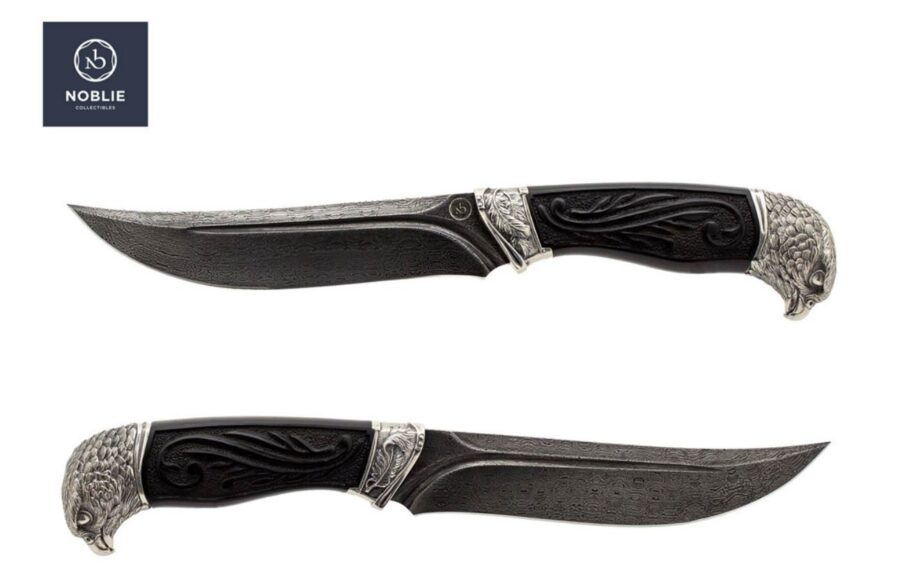
The Flying Falcon treats Damascus as one element in a larger piece of decorative knife work.
Its blade is made from 1080/15N20 carbon Damascus, with a published hardness of 59–60 HRC.
The knife measures approximately 290 mm overall, with a 150 mm blade that is about 5 mm thick.
Only five Flying Falcon knives were produced, making it a limited-series collector piece rather than a regular production model.
The handle centers on carved ebony. The guard and pommel are cast bronze with a silver finish, while engraved leaf decoration adds another layer of surface detail. At the rear, the pommel becomes a sculpted falcon head.
The knife is supplied with a leather sheath, walnut presentation box, certificate of authenticity, and gloves.
Those details matter because they explain why carbon Damascus makes sense here.
The Flying Falcon is not simply a working fixed blade with an upgraded steel option. The blade pattern is integrated with carving, engraving, casting, wood, and sculptural metalwork.
For a collector, much of the appeal comes from the relationship between those materials.
The Sebenza 31 Damascus

The Sebenza starts from a very different design philosophy.
A Large Sebenza 31 has a blade of approximately 3.61 inches / 91.7 mm, housed between titanium handle slabs.
Its construction revolves around the pivot, Reeve Integral Lock, ceramic lock interface, pocket clip, and the close tolerances associated with a modern high-end folding knife.
Damascus is offered within that existing mechanical platform.
The patterned blade can significantly alter the appearance of the knife, but it does not change its underlying purpose.
It remains a pocket folder.
That gives Damascus a different role than it has on the Flying Falcon.
On the Noblie fixed blade, Damascus belongs to a broader decorative composition.
On the Sebenza, stainless Damascus introduces visual complexity into a deliberately restrained titanium design.
What Close-Up Photography Can Reveal
Damascus rewards close inspection, but photographs need to be interpreted carefully.
A detailed photograph can reveal:
- transitions between the constituent steels;
- how the pattern moves through the bevel;
- differences between etched and polished surfaces;
- grind and finishing marks;
- interactions between blade geometry and pattern;
- surface texture created during finishing.
What a photograph cannot establish reliably is the actual depth of the etch.
Dark sections are not automatically deep valleys, and bright sections are not necessarily physically raised layers. Much of the contrast comes from differences in alloy chemistry and the way each material responds to polishing and etching.
A deeper etch can create noticeable physical relief. A lighter etch can produce strong visual contrast while leaving the blade comparatively smooth.
Without direct surface measurement, it is more accurate to discuss visible texture, contrast, and pattern definition rather than claiming a particular etch depth.
Why the Flying Falcon Offers More Visual Material
The greatest visual difference between these knives is not actually the Damascus.
It is everything surrounding the blade.
On the Flying Falcon, the eye moves from patterned steel into carved ebony, engraved foliage, bright metal fittings, and the sculpted falcon-head pommel.
Each material reacts differently to light.
The Damascus supplies alternating tonal structure. Ebony absorbs much of the light and emphasizes carved form. The silver-finished fittings create harder highlights around edges and engraved details. The sculpted pommel adds true three-dimensional relief.
That gives a photographer several distinct surfaces to work with before magnification is even involved.
The Sebenza is intentionally more restrained.
Its visual vocabulary is mainly Damascus, titanium, blade geometry, hardware, machining, and the transitions between them.
That simplicity has its own appeal, but it produces a different photographic subject.
The Flying Falcon is visually dense.
The Sebenza is deliberately controlled.
Fixed Blade vs Folder Matters More Than Damascus
The largest functional difference between these two knives has little to do with metallurgy.
The Flying Falcon uses a 150 mm fixed blade.
There is no pivot, lock, or internal handle clearance to engineer around. The maker can use substantial sculptural fittings, carved wood, a full guard, and decorative transitions without needing the knife to fold into a compact frame.
The Sebenza must solve a different mechanical problem.
Its blade has to rotate smoothly through a pivot, clear the handle, engage reliably with the lock, maintain correct detent behavior, and remain compact enough for pocket carry.
Those requirements influence proportions, materials, balance, construction, and decoration before blade steel even enters the discussion.
The Flying Falcon treats the knife as a complete decorative object.
The Sebenza treats the knife primarily as a precision folding mechanism.
Carbon Damascus and Corrosion
Carbon Damascus requires more owner attention.
After handling, moisture and fingerprints should not remain on the blade for extended periods. The knife should be stored dry, and a thin protective coating is useful when it will sit unused for a longer period.
That matters particularly with a collector knife because corrosion is not only a functional problem.
It can alter the etched finish and affect the contrast that gives Damascus much of its visual appeal.
A knife such as the Flying Falcon is therefore best treated like other high-end pieces made from reactive carbon steel: keep the blade clean, keep it dry, and protect the surface during storage.
Stainless Damascus and Corrosion
Stainless Damascus is considerably more forgiving.
That makes it a logical material for a folder that may be handled and carried frequently.
But stainless should never be interpreted as incapable of corrosion.
A stainless Damascus blade still contains multiple alloys, has an etched surface, and can encounter fingerprints, humidity, salts, food acids, and water.
Reasonable maintenance still applies.
The difference is one of degree rather than an absolute divide.
A stainless Damascus Sebenza is generally a more practical proposition for routine handling than a 1080/15N20 carbon-Damascus collector blade, but neither benefits from neglect.
Does 59–60 HRC Make the Flying Falcon Better?
No single Rockwell hardness figure can answer that question.
The Flying Falcon is specified at 59–60 HRC, which is useful information, but hardness is only one part of blade performance.
Other variables include:
- edge geometry;
- blade thickness;
- heat treatment;
- steel composition;
- sharpening angle;
- intended cutting task.
Damascus does not automatically gain a performance advantage merely because multiple steels are present.
Pattern welding is a method of constructing the steel.
A well-made Damascus blade can perform very well, but actual cutting behavior still depends on the alloys, heat treatment, geometry, and edge.
For the same reason, comparing the Flying Falcon’s 59–60 HRC directly with an unrelated hardness figure for a non-Damascus Sebenza would not tell us much.
Flying Falcon vs Sebenza 31 Damascus: Key Differences
The two knives can be summarized more usefully as a set of practical differences:
| Feature | Noblie Flying Falcon | Sebenza 31 Damascus |
| Knife type | Fixed blade | Folding knife |
| Damascus | 1080/15N20 carbon Damascus | Offered with Chad Nichols stainless Damascus |
| Blade length | 150 mm / 5.91 in | Approx. 91.7 mm / 3.61 in (Large) |
| Blade thickness | 5 mm | Approx. 3.1 mm (Large) |
| Published hardness | 59–60 HRC | Depends on the specific Damascus configuration |
| Handle construction | Carved ebony with decorative metal fittings | Titanium |
| Lock | None required (fixed blade) | Reeve Integral Lock |
| Decorative treatment | Damascus combined with carving, engraving, cast fittings and sculptural work | Patterned steel inside a restrained titanium design |
| Production | Limited series of five | Premium production folder offered in various configurations, including Damascus versions |
| Maintenance | Conventional carbon-steel care | More corrosion resistant, but still benefits from normal maintenance |
| Primary role | Collector and presentation fixed blade | High-end EDC folder |
Limited-Series Collector Knife vs Premium EDC
This is where the two knives separate most clearly.
The Sebenza makes sense for someone who wants Damascus without giving up the format of a modern pocket knife.
It folds into a compact titanium frame. It has a pocket clip. Its design is centered on mechanical simplicity, tight construction, and regular handling.
Stainless Damascus complements that purpose because it adds a distinctive blade pattern while remaining comparatively practical to maintain.
The Flying Falcon is aimed at a different kind of ownership.
Only five were made. Its 150 mm Damascus blade is surrounded by carved ebony, engraved detail, silver-finished bronze, and sculptural metalwork. It is accompanied by a sheath and presentation box rather than being designed around pocket carry.
The Damascus blade is one part of a broader decorative composition.
That distinction matters when comparing expensive knives.
A collector knife does not have to justify its price through cutting performance alone. Rarity, materials, carving, engraving, casting, finishing, and the amount of skilled work represented in the complete object can all contribute to its appeal to a collector.
A high-end folder generally places more emphasis on different qualities: machining, mechanism, tolerances, ergonomics, portability, lock design, and repeatable everyday operation.
Both can be high-end knives without being high-end in the same way.
Which Type of Damascus Makes More Sense?
Choose carbon Damascus when the patterned steel is an important part of the traditional craft and visual identity of the knife.
It makes particular sense on custom or limited-series fixed blades where a strong etched pattern can work alongside carving, engraving, natural handle materials, and decorative fittings.
The Flying Falcon is a clear example.
Its 1080/15N20 blade cannot really be separated from the rest of the composition. The Damascus pattern is one visual layer among several.
Choose stainless Damascus when you want the appearance of patterned steel in a knife intended for more regular handling or pocket carry.
The Sebenza 31 demonstrates that approach. Damascus gives an otherwise restrained titanium folder considerably more visual character while retaining the practical advantages associated with corrosion-resistant blade materials.
Neither one is “real Damascus” while the other is somehow less authentic.
Both can be genuine forged, pattern-welded Damascus.
The useful questions are different:
- What alloys were used?
- How was the pattern created?
- How was the blade heat treated?
- How corrosion-resistant is the steel?
- How much maintenance will it require?
- What kind of knife was the material selected to create?
That is the meaningful distinction between carbon Damascus and stainless Damascus—not whether one was forged and the other was not.
EXPLORE SOMEWHERE NEW
Nothing found.
BUY A PRINT
All photos on this site are available as limited edition fine art photographic prints. Please get in touch for sizes and rates.